

Here's what nobody tells you about the Instant Pot Duo: the first time you use it, you will be a little bit scared. The steam hisses, the lid locks tight, and you stand there wondering if you've made a terrible mistake with dinner for six. I know because that was me, three years ago, on a Tuesday night in our kitchen outside Columbus, Ohio, with four hungry kids and a husband who kept glancing at the ceiling every time the pot made a noise. I had bought the 6 quart Instant Pot Duo because I was tired of trying to get six people fed out of one oven and a few burners. What I didn't know was how long it would take me to trust it.
Every review you read shows the same picture: a perfect pot roast, steam curling up, everyone smiling. Nobody photographs the part where you read the manual twice, or the first batch of food that comes out bland because you didn't understand the keep warm setting yet. This is that honest review. I've cooked for six people most nights for more than a decade, and I've owned this Instant Pot Duo for three years. It earns its place on my counter, but not always for the reasons you see in the ads. Let me show you what actually happened.
The Quick Verdict
The Instant Pot Duo is the rare appliance that earns its counter space in a busy family kitchen, but it has a real learning curve, a heavy pot, and a sauté mode that will never replace your skillet.
Amazon Check Today's Price →The honest version: it's worth it, with a learning curve
Three years of weeknight dinners for six, and this is the one appliance I would buy again. It's not perfect, and I'll show you exactly where it falls short. Check today's price on Amazon and decide with both eyes open.
Amazon Check Today's Price on Amazon →How I've Used It
Our weeknights run on a clock. School pickup at 3:15, practice at 5:00, dinner at 6:00, homework after. For years, dinner was whatever I could get on the table fastest, which usually meant one pan of something and a lot of side dishes from a bag. The Instant Pot Duo changed the order of operations. Now I can start dried beans or a pot roast in the afternoon, walk away to help with homework, and come back to dinner that's actually done.
Here's the honest part: it didn't replace my oven. It replaced the slow cooker, the rice cooker, and the yogurt maker, three appliances that lived in my cabinets and came out a few times a year. The Instant Pot sits on the counter and gets used four or five times a week. That's the real win. A gadget you use beats a perfect gadget you don't.
In the first month, I only used two functions: pressure cook and sauté. Then I tried the rice setting, then the steam setting, then yogurt. The 13 one-touch programs felt overwhelming at first, so I ignored most of them and just used the ones that matched what I was already cooking. That's the way to learn this machine. You don't need all 13 programs on day one.
My most-used recipe is the Sunday pot roast. I brown the roast in the sauté function, add broth, set the pressure cook for about 90 minutes, and walk away to get ready for church. By the time we're home, the house smells like dinner and the roast is tender enough to fall apart with a fork. For six people, one pot roast plus potatoes and a pan of cornbread is a full meal, and the Instant Pot is the reason it happens on a Sunday instead of a holiday.
What Nobody Tells You About the Learning Curve
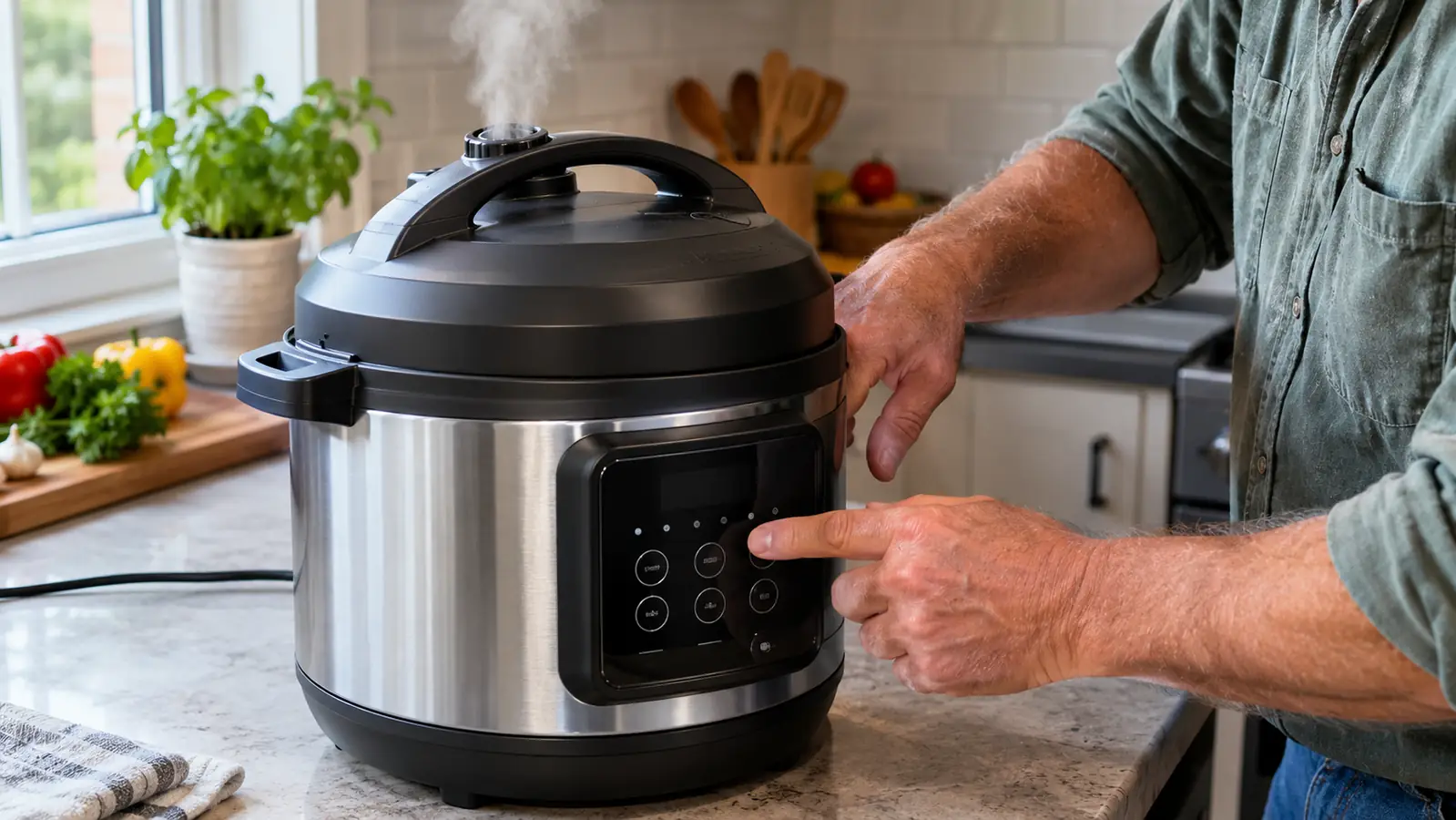
The first thing nobody tells you is that the Instant Pot is loud when you're not used to it. The steam hisses, the lid seals, and the whole thing sounds like a small engine warming up. My husband Mark still flinches when the pressure releases. You get used to it by about the fifth meal, but those first five meals, you will hover.
The second thing nobody tells you is that the manual is not the place to learn this machine. I read it twice and still undercooked my first pot of beans, because I didn't let the pressure come down long enough before opening the lid. The fix is simple once you know it: give the pot ten minutes to release steam on its own, then release the rest. But nobody tells you that in the box.
The third thing is that you will burn something in sauté mode at least once. It runs hot, and hot means sticking if you're not paying attention. I burned a batch of onions so badly that we ate dinner by candlelight to hide the smoke. It happened once. After that, I learned to stir more and walk away less. These are the lessons that don't make it into the pretty reviews.
And then there's the first meal that goes right. For me, it was a pot of chili, the kind I used to simmer for two hours while the kids whined about being hungry. The Instant Pot had it done in about 35 minutes, and it tasted like it had cooked all afternoon. That's the moment the machine goes from scary to indispensable. Nobody tells you that the switch flips that fast, but it does.
The Seven Functions, Ranked by How Often I Actually Use Them
The Instant Pot Duo has seven cooking functions: pressure cook, slow cook, sauté, steam, rice, yogurt, and keep warm. After three years, here's my honest ranking by how often each one actually gets used in a house with six people.
Pressure cook is the workhorse. Chili, beans from dried, shredded chicken for tacos, pot roast on Sundays, all of it happens under pressure. The claim of up to 70% faster than slow cooking holds up in practice. A pot roast that would have simmered all day in the slow cooker is done in about 90 minutes, and it tastes like it simmered all day.
Sauté is second, because almost every pressure recipe starts with browning. Slow cook is third, and I use it mostly on Sundays when I'm home anyway and want the house to smell like dinner. Rice is fourth. It makes good rice, not perfect rice, and I've learned to live with that. Steam is fifth, mostly for vegetables when I'm already using every burner. Yogurt is last, but I use it twice a month and I'm glad I have it.
Keep warm deserves its own mention, because it's the function that saves dinner on the nights practice runs late. The pot switches to keep warm automatically when the cooking cycle ends. When Hannah's basketball practice runs over and we don't sit down until 6:30, the chili is still hot and the chicken hasn't dried out. That one feature has saved more weeknights than any other part of this machine.
What Nobody Tells You About the Sauté Function
The sauté function is genuinely good, because the inner pot is stainless steel with a tri-ply bottom, which means it heats evenly enough to brown meat and onions. But here's what nobody tells you: it's not a skillet. It runs hotter than you expect, and stainless steel sticks if you don't have enough fat in the pot. The first time I tried to brown chicken without oil, I had to soak the pot.
The workaround is simple. Brown in smaller batches, use a little oil, and deglaze with broth or water before you add the rest of the ingredients. That last step is the one that makes the whole thing work. The browned bits lift off the bottom and become the flavor of the dish. In a regular skillet, you'd transfer everything to a pot and wash two pans. Here, you brown and pressure cook in the same pot, and the only extra dish is the lid.
The Instant Pot Duo didn't replace my oven. It replaced the three appliances I was never quite happy with, and it does their job well enough that I stopped missing them.
What Nobody Tells You About Size, Weight, and Cleanup
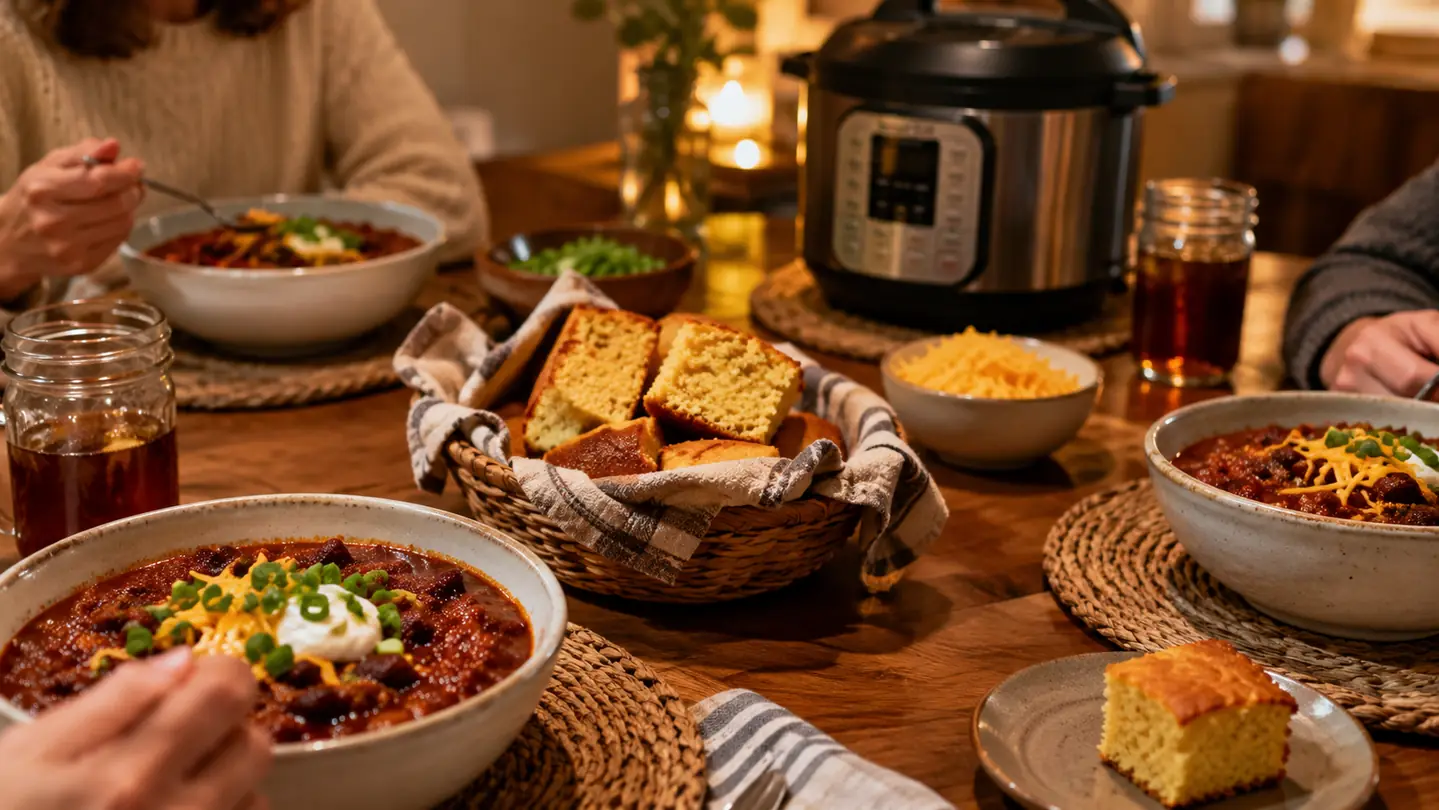
Let's talk about the physical reality of owning a 6 quart Instant Pot, because nobody does. The pot holds 5.68 liters, which is the right size for six people. I can fit a whole chicken or a large pot roast in there, plus enough chili to feed my family and still have leftovers for lunch. If you cook for fewer than four people, the 6 quart will feel too big. For us, it's exactly right. But it weighs 14.6 pounds, and it measures 12.2 inches deep, 13.38 inches wide, and 12.48 inches tall. That's a real footprint on a builder-grade counter. I keep mine on the counter anyway, because I know myself: if I stored it in a cabinet, I would use it three times a year and then write a review saying it wasn't worth it. The honest truth is that the Instant Pot is only worth it if it lives where you can see it.
The inner pot is heavy when it's full. I carry it to the table with both hands and set it on a trivet, and I never let the kids carry it. There's also a second lid, an inner lid that catches condensation while you cook. It's one more small thing to wash, but it does its job. The outer lid locks, the inner lid lifts out, and after a week of chili and beans, both of them smell like chili and beans until you wash them.
The stainless steel inner pot is the best part of cleanup. Most nights, it's the only pot I wash by hand, and it rinses clean easily. I don't use the dishwasher for it, because hand washing takes less time than walking to the other side of the kitchen. The tri-ply bottom means food doesn't scorch as easily as it would in a thinner pot. Here's the honest catch: the lid has parts. The outer lid, the inner lid, and the little pieces in between all need a wipe down after every cook. It's not hard, and it takes about a minute, but it's not the one-and-done cleanup the ads imply. I've learned to wash the inner pot, wipe the lids, and leave everything to air dry on the counter. That routine takes me less time than cleaning a slow cooker and a rice cooker would have taken separately.
One more thing about living with this pot: it doubles as the serving dish. On taco nights, I set the inner pot on a trivet in the middle of the table and everyone serves themselves straight from it. That's one less bowl to wash, and for six people, one less bowl matters. Leftovers go straight into containers from the same pot, and by the time dinner is over, the pot is empty and already half clean. It's a small thing, but small things are what a weeknight is made of.
What I Liked
- Seven cooking functions in one pot: pressure cook, slow cook, sauté, steam, rice, yogurt, and keep warm
- Stainless steel inner pot with a tri-ply bottom that sears and browns well
- Cooks up to 70% faster than slow cooking, which matters on a weeknight
- 13 one-touch programs make it easy once you learn the basics
- One pot to wash for most meals, and the lids wipe down in about a minute
- 1 year manufacturer warranty and a huge community of recipes online
Where It Falls Short
- Heavy at 14.6 pounds and big at 12.2 by 13.38 by 12.48 inches, so it needs real counter space
- Real learning curve: the first few cooks are loud and easy to get wrong
- Sauté mode runs hot and can stick if you don't use enough oil
- Rice is good but not perfect, so rice purists will still reach for a dedicated cooker
- The lid has several parts to clean, not just the pot
- Keep warm can overcook food if you leave it on for hours
Who This Is For
This is for the parent who cooks for four to six people most nights and is tired of washing three pots to make one dinner. It's for the family that already owns a slow cooker, a rice cooker, and a yogurt maker, and would rather own one machine that does all three jobs well enough. It's for people who will honestly use it: people who leave it on the counter, learn the learning curve, and accept that sauté is not a skillet. If you cook beans from dried, make a weekly pot roast, or need dinner to stay warm until practice ends, the Instant Pot Duo will earn its place.
The Instant Pot also earned its spot on Sundays, when we host extended family after church. I've carried a full pot of pulled pork to more potlucks than I can count, and it's always the thing that comes home empty. For a family that feeds six on a normal night and twelve on a good Sunday, having one pot that scales is worth more than any fancy feature.
Who Should Skip It
Skip it if you cook for one or two people, because the 6 quart will feel enormous and you'll spend your life scraping leftovers into smaller containers. Skip it if you hate learning curves and want every meal to work on the first try, because the first five meals will teach you things. Skip it if you're shopping for a set-and-forget slow cooker, because the pressure cooker is not that: it has steps, and the steps matter. And skip it if you have a tiny kitchen with no counter space, because a 14.6 pound machine that lives in a cabinet is a machine you won't use. There's no shame in any of that. The Instant Pot is a tool, not a personality, and it only works if it fits your actual life.
Still deciding? Here's what I'd tell a friend
For a household of six, the 6 quart Instant Pot Duo is the right size and the right amount of machine. Expect one noisy week of learning, then years of one-pot dinners. Check today's price on Amazon and see if it fits your kitchen.
Amazon Check Today's Price on Amazon →