
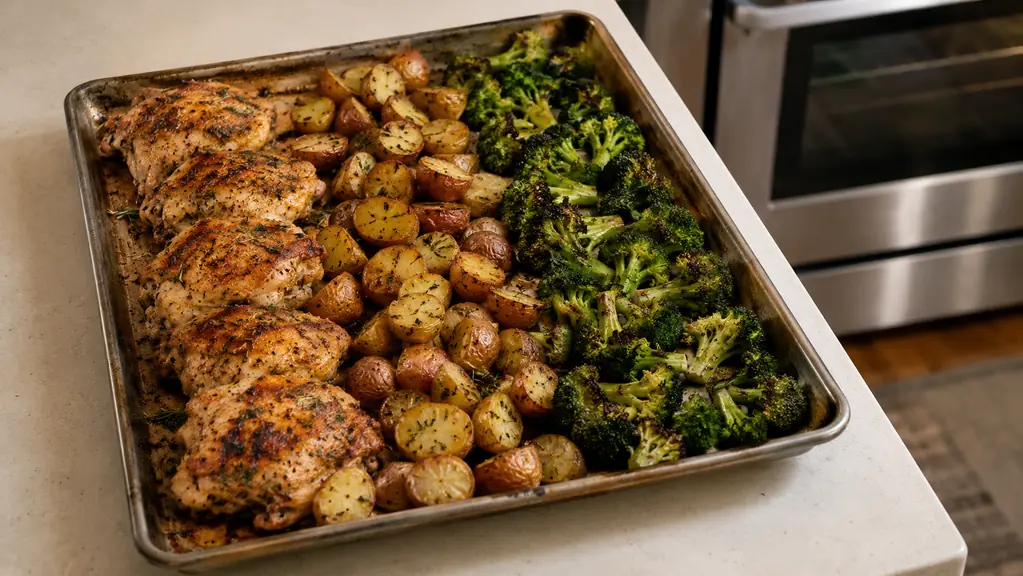
You know the 5:45 feeling. Everyone is hungry, practice ends in twenty minutes, and the only plan you have is the one where you stand in front of the open fridge hoping something counts as dinner. I have fed six people most nights for over a decade, and the method that saves me more times than any other is the sheet pan dinner. Not because I am a great cook. Because a half sheet pan turns the whole oven into one big cooking surface, and that means one pan to fill, one pan to wash, and six plates that all get filled at the same time.
The trick is not a recipe. The trick is a system: pick your protein, pick your vegetables, pick your starch, cut everything to the same size, and let the pan do the rest. I have made this exact dinner hundreds of times, and the Nordic Ware half sheet pans in my cabinet are the ones I reach for every single time. Here is the whole method, step by step, the way I actually do it on a Tuesday.
The pan that makes weeknight dinner possible
You do not need a fancy gadget to make this dinner. You need one sturdy half sheet pan that fits a standard oven and will not warp under a hot roast. This is the one I have used for years.
Amazon Check Today's Price on Amazon →Step 1: Set Up Your Pan Before You Touch Any Food
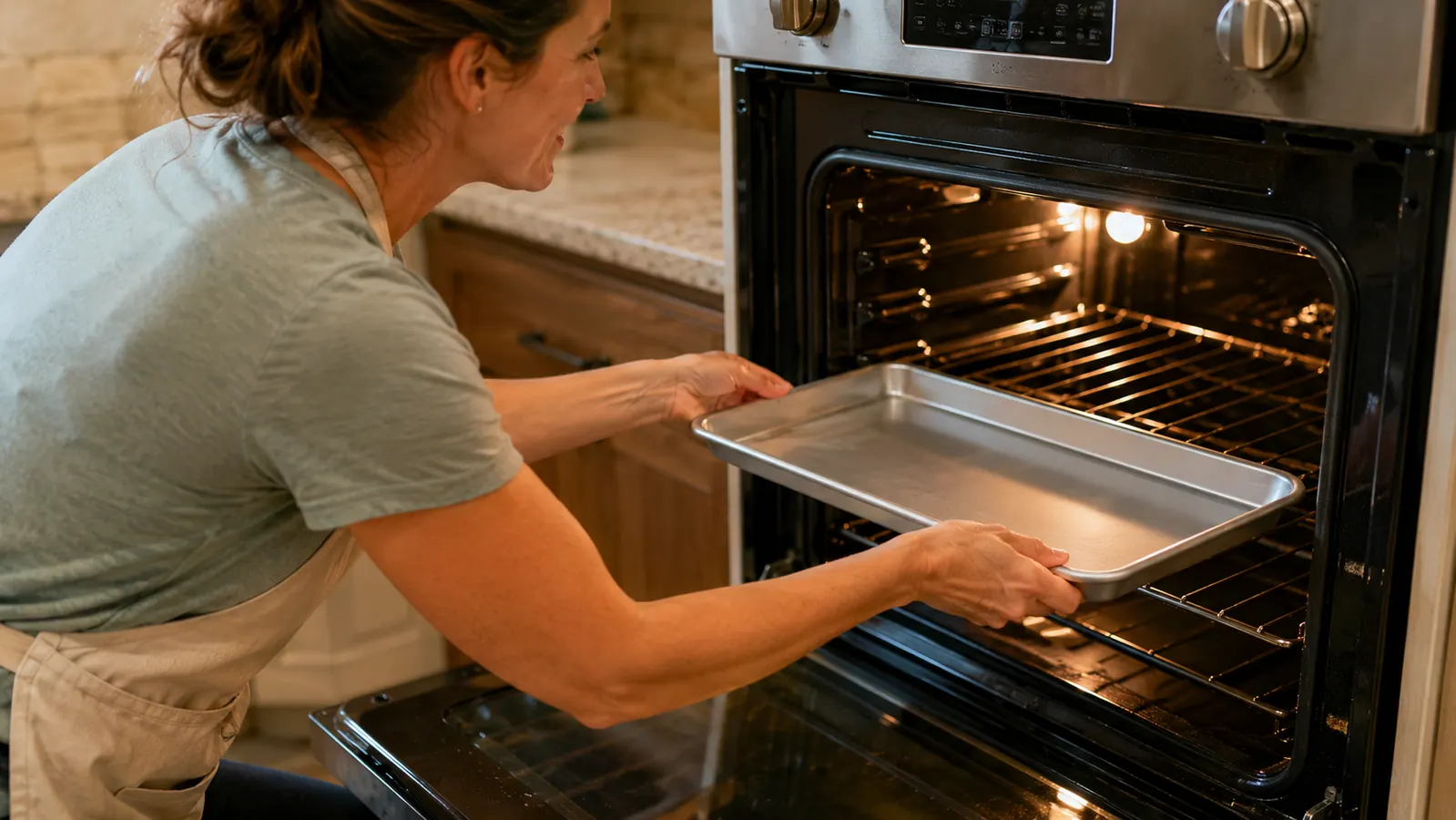
Line the pan with foil or parchment first, while the pan is still dry and clean. I know it feels like an extra step, but it is the difference between a five minute cleanup and a twenty minute soak. I use heavy duty foil and I do not worry about making it perfect. Tear off a piece a few inches longer than the pan on each side, press it over the edges, and crimp it gently around the rim. The Nordic Ware Naturals half sheet has an encapsulated galvanized steel rim that makes this easy, because the rim stays cool enough to touch and gives the foil something to grip.
If you use parchment instead, you do not need to line the sides, just the bottom. Both work. The point is that the pan itself should never see a scrubbing pad. My pans are years old and still look nearly new, which is why the lifetime limited warranty on these pans has never had to do any work at my house.
I learned this the hard way on a Sunday in March, the first time I made a sheet pan dinner without lining the pan. I had roasted a whole pan of chicken thighs and potatoes, the dinner was great, and then I spent forty minutes at the sink with hot water and a scrub brush while the kitchen filled with steam and my oldest asked three times where his math homework was. The baked-on spots laughed at the brush. I finally let the pan soak overnight and attacked it again in the morning. Now I line the pan before I even turn on the oven, and I keep a roll of heavy duty foil in the drawer right under the counter so I never have an excuse to skip it. I keep the foil in the same drawer as the parchment, so there is no decision to make, just grab whichever is closer. The whole step takes thirty seconds. The cleanup after an unlined pan took me the better part of an evening. Thirty seconds is the better deal.
Step 2: Cut Everything the Same Size
This is the whole idea of a sheet pan dinner, and it is not glamorous. Cut your potatoes into halves or quarters so they are about an inch thick. Cut your broccoli into florets that are roughly the same size. If you are using chicken thighs, they can stay whole, but if you are using chicken breasts, slice them into two or three pieces so they cook at the same speed as everything else.
The pan itself is 17.9 by 12.9 by 1 inches on the outside, with an interior of 17.1 by 12.1 inches. That is a lot of real estate, but it is not endless. If you crowd the pan, everything steams instead of roasting, and you get pale, soggy food. Give each piece a little breathing room. For six people, I fill the pan about three quarters full and no more. If it will not fit with space between the pieces, I use a second pan or I cook in two rounds.
The night I learned this, I had cut a bag of red potatoes into uneven chunks because I was rushing, some the size of golf balls and some the size of my thumb. I told myself it would be fine. It was not fine. At the 25 minute mark the little pieces were already dark and crisp, and the big pieces were still hard in the middle, so I had to fish out the small ones, put the pan back for ten more minutes, and then explain to my youngest why her potatoes were late. The whole dinner still got eaten, but it was the kind of meal that makes you want to quit sheet pan cooking, not repeat it. Now I take the extra minute to make everything roughly the same size, and I check myself on the crowded part too. A full pan of food that steams instead of roasting taught me that the second time. It also taught me that a half sheet pan holds a lot, but it does not hold everything.
Step 3: Season in the Pan, Not in Separate Bowls
Here is where I save myself a sink full of bowls. Put the cut vegetables on the pan first, drizzle with oil, and sprinkle your seasoning right over the pan. Toss them with your hands or a spatula right on the pan. Then add the protein, season it the same way, and give it a quick turn so the seasoning is on both sides. One pan, zero extra bowls, and the cleanup stays exactly as small as you planned it.
For the seasoning, keep it simple: salt, pepper, garlic powder, and maybe a pinch of paprika. You can get fancy later. The important thing is that the oil goes on the food, not just in the pan, and that you use enough. Dry food roasts unevenly and sticks to the foil. I use about two tablespoons of oil for a full pan, drizzled in a zigzag so it lands everywhere. If I am using two pans, I season each one right before it goes in, so the oil does not pool while the first pan waits.
Step 4: Roast at 425 and Do Not Peek
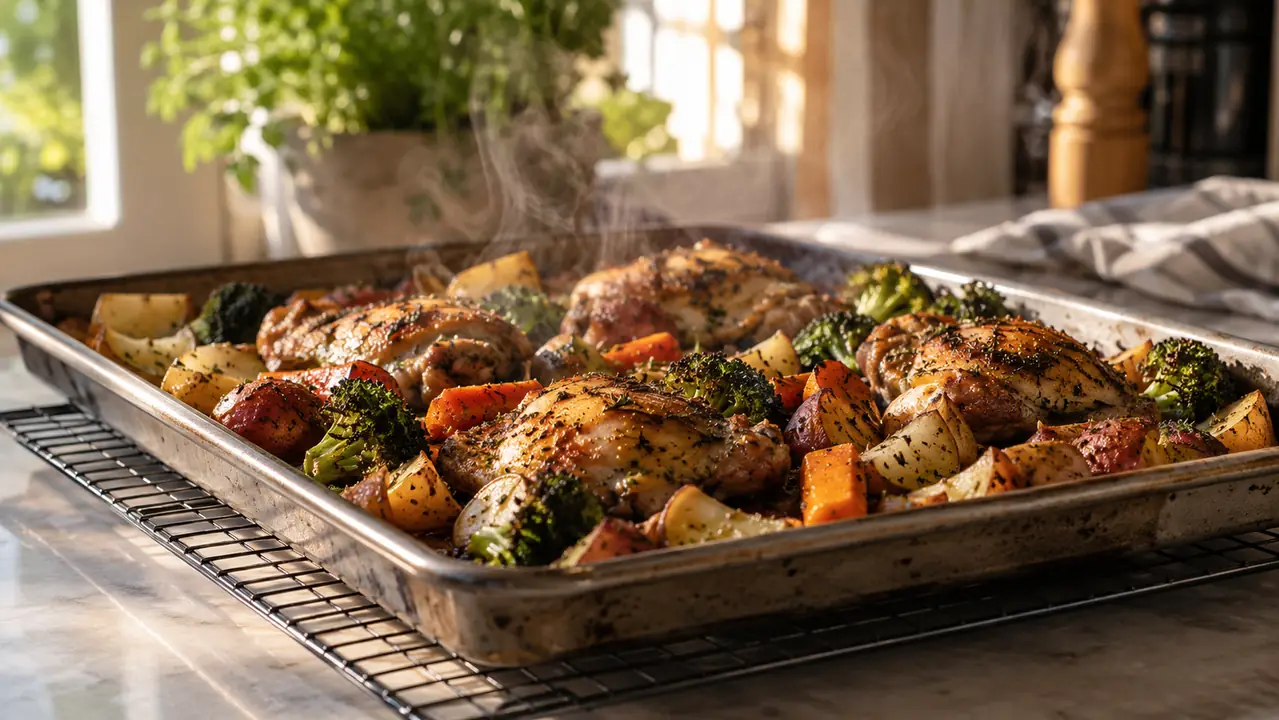
I roast almost every sheet pan dinner at 425 degrees Fahrenheit. That temperature browns the outside of the food before the inside dries out, which is exactly what you want from a one pan meal. Slide the pan onto the middle rack and set a timer for 25 minutes. Then walk away. Every time you open the oven door, the temperature drops and the food takes longer. I know it is tempting to check. Do not.
At the 25 minute mark, pull the pan out, give everything a good stir or a flip with a spatula, and put it back for another 10 to 15 minutes. The total time depends on what you are cooking. Chicken thighs and potatoes usually need about 40 minutes. Fish and green beans need less. The pan itself handles the heat beautifully because it is made of pure aluminum, which conducts heat evenly, so I do not get hot spots where one end burns and the other end is raw.
I proved this to myself on a Wednesday in October. I had a chicken sausage and sweet potato dinner in the oven, the kids were doing homework at the table, and I kept opening the door to check on it, probably six or seven times in the first twenty minutes. That dinner took almost an hour and the potatoes still came out uneven, because every time I opened the door the oven had to climb back up to temperature. The next week I set the timer, went and folded a load of laundry in the basement, and did not open the oven once until the timer went off. Same recipe, same pan, done in about 38 minutes, and the potatoes were actually brown on the edges. I have not stood over the oven door since. Now I use the oven light if I really need to look, and I try not to even do that. The oven does its job when you let it.
Step 5: Rest, Then Serve Straight From the Pan
When the timer goes off, pull the pan out and let it rest for five minutes before you serve. This is not a fancy culinary step. It is a practical one. The food settles, the juices redistribute, and you do not burn your fingers trying to serve piping hot chicken straight off the metal. The rim on the Nordic Ware pan stays cooler than the cooking surface, which makes it easier to grip, but I still use a towel or pot holder.
Then I put the pan right on the table on a trivet or a folded towel and let everyone serve themselves. My kids are far more likely to eat broccoli when they are the ones putting it on their own plate. The pan goes back to the kitchen nearly empty, and because I lined it with foil, cleanup is just the foil, one spatula, and the pan itself. That is the whole dinner and the whole cleanup.
What Else Helps
A few things make this dinner even easier. Keep a bag of frozen vegetables in the freezer for the nights when the fresh produce in the fridge looks sad. Frozen broccoli, green beans, and pepper strips roast beautifully from frozen, you just add five minutes to the cook time. Keep your seasonings in a small basket near the stove so you do not have to hunt for the garlic powder while the oven is preheating. And if you are cooking for a crowd or a potluck, buy the two pack of Nordic Ware half sheet pans so you can run two pans at once, one on the middle rack and one on the lower rack, and swap them halfway through. That is how I feed the church potluck without breaking a sweat.
One more thing: do not be afraid to use the broiler for the last two minutes if you want extra crisping on the potatoes. Watch it the whole time, because the broiler is fast and unforgiving. The pan can handle it, the pure aluminum construction is built for high heat, but the food will go from golden to black faster than you think.
The two pan trick saved me last month when the church potluck landed on the same Sunday as a family birthday. I roasted one pan of sausage, peppers, and onions and one pan of chicken thighs and potatoes, put the first pan on the middle rack and the second on the lower rack, and swapped them top to bottom at the halfway point so both got the hotter air. Everything came out at the same time, I carried both pans to the car in one trip, and the only thing I brought home was the empty foil. I have also learned to write the cook time on the foil with a marker before I put the pan in the oven, because when you are juggling two pans and a potluck, you will not remember whether the chicken went in at 5:10 or 5:15. I write the time in big numbers with a regular marker, nothing fancy, and it has saved me more than once.
The whole dinner is one pan to fill, one pan to wash, and six plates that all get filled at the same time. That is the entire trick.
Start your own sheet pan habit tonight
You do not need a new recipe collection or a fancy kitchen. You need one good pan and a method you can repeat without thinking. This is the pan I have used for years, and it is the one I would buy again.
Amazon Check Today's Price on Amazon →